
Interpreting graphs worksheets (PDF) offer valuable practice in data analysis, crucial for students and professionals alike. These resources enhance analytical skills, fostering comprehension of visual information.
What are Graph Interpretation Worksheets?
Graph interpretation worksheets are educational tools designed to assess a student’s ability to extract meaning from visual representations of data. Typically available in PDF format for easy access and printing, these worksheets present various types of graphs – bar graphs, line graphs, pie charts, and scatter plots – accompanied by questions.
These questions prompt students to analyze trends, identify key data points, compare different sets of information, and draw conclusions based on the presented visuals. They often require students to read scales, understand labels, and interpret titles to accurately decipher the information conveyed by the graph. The goal is to build critical thinking and analytical skills.
Why are Graph Interpretation Skills Important?
Graph interpretation skills are fundamental across numerous disciplines and real-life scenarios. The ability to accurately read and understand graphs is crucial in fields like science, mathematics, economics, and social studies. These skills empower individuals to make informed decisions based on data, rather than relying on assumptions.
Furthermore, interpreting graphs fosters critical thinking, analytical reasoning, and problem-solving abilities. In today’s data-rich world, being able to quickly and effectively decipher visual information presented in graphs is a highly valued skill. Worksheets (PDF) provide targeted practice, building confidence and competence in this essential area.
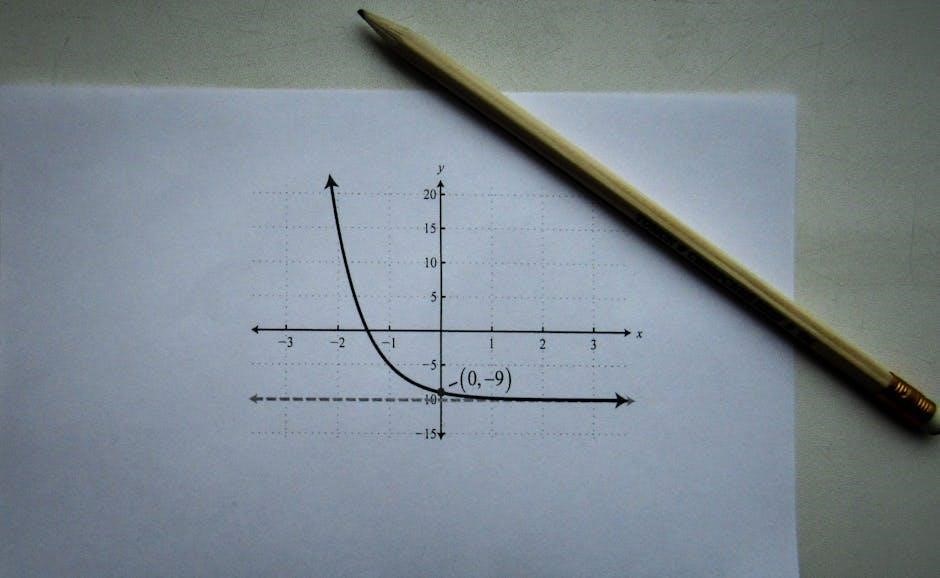
Types of Graphs Commonly Found in Worksheets

Worksheets frequently feature bar graphs, line graphs, pie charts, and scatter plots, each designed to visually represent different types of data relationships.
Bar Graphs: Understanding Categorical Data
Bar graphs excel at displaying categorical data, where distinct groups or categories are compared using rectangular bars. The length of each bar corresponds to the frequency, count, or percentage of that category. Worksheets utilizing bar graphs often ask students to identify the category with the highest or lowest value, calculate differences between categories, or interpret the overall distribution of data.
Understanding the axes is key: one axis represents the categories, while the other displays the scale of measurement. Students must carefully read the labels and scale increments to accurately extract information. These graphs are foundational for developing skills in comparing discrete data sets and drawing conclusions about relative magnitudes. Analyzing bar graphs builds a strong base for more complex data interpretation.
Line Graphs: Tracking Changes Over Time
Line graphs are specifically designed to illustrate trends and changes in data over time. Data points are plotted and connected by lines, visually representing how a variable evolves. Worksheets featuring line graphs commonly require students to identify increasing or decreasing trends, pinpoint maximum and minimum values, and predict future values based on established patterns.
Interpreting these graphs necessitates a keen focus on both axes – the horizontal typically represents time, while the vertical displays the measured variable. Understanding the scale and intervals is crucial for accurate data reading. Students learn to analyze the slope of the line to determine the rate of change and draw informed conclusions about the data’s behavior.
Pie Charts: Representing Proportions
Pie charts excel at displaying parts of a whole, showcasing proportions and percentages with circular segments. Worksheets utilizing pie charts often ask students to determine the fraction or percentage each segment represents, compare the sizes of different segments, and calculate the total value based on segment information.

Successfully interpreting these charts requires understanding that the entire circle represents 100% of the data. Students must be able to visually estimate the relative sizes of the segments and translate those estimations into numerical values. Exercises frequently involve calculating the central angle of each segment to reinforce the relationship between proportions and degrees.
Scatter Plots: Exploring Relationships Between Variables
Scatter plots are powerful tools for visualizing the relationship between two different variables. Worksheets featuring scatter plots challenge students to identify patterns, such as positive, negative, or no correlation, between the plotted data points. Analyzing these plots helps determine if one variable influences another.
Interpreting scatter plots involves recognizing clusters, outliers, and the general trend of the data. Students learn to draw lines of best fit to represent the overall relationship and make predictions based on the plotted points. Exercises often ask about the strength of the correlation and whether it suggests a causal link, emphasizing the difference between correlation and causation.

Key Elements to Focus on When Interpreting Graphs
Understanding graph components – titles, axes, scales, and data points – is fundamental for accurate interpretation. Careful analysis unlocks insights from visual data.
Titles and Labels: The Foundation of Understanding
Titles and labels are the initial keys to unlocking a graph’s meaning. A clear, concise title immediately establishes the graph’s subject matter, providing essential context. Axis labels are equally vital; they define the variables being measured and their corresponding units.
Without proper labeling, data points become meaningless. Worksheets often test comprehension by asking students to identify what each axis represents. Pay close attention to units – are we dealing with meters, kilograms, or years? Misinterpreting units leads to incorrect conclusions. Labels also extend to legends in graphs with multiple data series, clarifying which line or bar corresponds to which category. Thoroughly examining these elements builds a solid foundation for accurate interpretation.
Axes: Identifying Independent and Dependent Variables
Understanding the roles of the x and y axes is fundamental to graph interpretation. The independent variable, often manipulated or controlled, is typically plotted on the x-axis (horizontal). This is the factor you change. Conversely, the dependent variable, which responds to changes in the independent variable, resides on the y-axis (vertical).
Worksheets frequently assess this concept by asking which variable is being affected by the other. Recognizing this relationship is crucial for drawing valid conclusions. For example, if time is on the x-axis and distance traveled is on the y-axis, time is independent – it’s what’s changing – and distance is dependent, as it changes because of time. Correctly identifying these variables unlocks the story the graph tells.
Scales: Recognizing Increments and Units
Graph scales dictate how values are represented, and accurate interpretation hinges on understanding them. Increments are the consistent steps between markings on an axis – are they 1s, 5s, 10s, or something else? Units specify what is being measured (e.g., seconds, meters, dollars).
Worksheets often test your ability to read values precisely. A poorly understood scale leads to misinterpretation. For instance, a y-axis labeled “Sales (in thousands)” means a value of ‘5’ actually represents 5,000, not just five. Pay close attention to the labels and the spacing to avoid errors. Mastering scale reading is essential for extracting accurate data points.
Data Points: Extracting Specific Information
Data points are the individual markers on a graph representing specific values. Interpreting graphs worksheets frequently require you to pinpoint exact data values. This involves locating the intersection of an x and y coordinate and then accurately reading the corresponding value from each axis.
Precision is key! Don’t simply estimate; use the gridlines to help you. Worksheets may ask for values at specific points or require you to identify the data point representing a particular scenario. Understanding the scale (as discussed previously) is crucial for correctly extracting this information. Practice makes perfect in accurately identifying and interpreting data points.

Common Questions Answered by Graph Interpretation Worksheets
Worksheets assess understanding by asking about trends, predictions, comparisons, and value calculations directly from the presented graphical data, building analytical skills.
Identifying Trends: Increasing, Decreasing, or Constant
Interpreting graphs worksheets (PDF) frequently challenge students to pinpoint trends within datasets. Recognizing whether a line on a graph is consistently rising indicates an increasing trend, signifying growth or positive correlation. Conversely, a downward slope reveals a decreasing trend, suggesting decline or negative correlation.
However, not all graphs showcase change; a horizontal line represents a constant trend, meaning the value remains stable over the observed period. Worksheets often present scenarios requiring students to describe these trends in context, for example, “Sales increased steadily from January to June.” Mastering trend identification is fundamental to drawing meaningful conclusions from graphical representations and is a core skill reinforced by these resources.
Making Predictions: Extrapolating Data
Interpreting graphs worksheets (PDF) often assess a student’s ability to extrapolate data – to predict future values based on established trends. This involves extending the graph’s line or curve beyond the provided data points, assuming the existing pattern continues. Worksheets might ask, “If this trend continues, what will the population be in 2030?”
It’s crucial to understand extrapolation isn’t foolproof; real-world factors can alter trends. However, these exercises build logical reasoning and mathematical skills. Students learn to visually estimate values and apply proportional reasoning. Successfully extrapolating data demonstrates a strong grasp of the graph’s underlying relationship and the ability to apply it to hypothetical scenarios.
Comparing Data Sets: Analyzing Differences
Interpreting graphs worksheets (PDF) frequently present multiple datasets on a single graph or across several. A key skill is accurately comparing these sets to identify differences and similarities. Questions might ask students to determine which dataset experienced the greatest growth, or to quantify the gap between two trends at a specific point in time.
This requires careful observation of lines, bars, or sections of pie charts. Students must analyze slopes, heights, and proportions to draw meaningful conclusions. Worksheets often emphasize using comparative language – “greater than,” “less than,” “similar to” – to articulate observed differences. Mastering this skill builds analytical thinking and the ability to synthesize information from visual representations.
Calculating Values: Reading Data from the Graph
Interpreting graphs worksheets (PDF) often assess a student’s ability to extract precise data points. This involves accurately “reading” values directly from the graph’s axes. For example, a line graph question might ask for the value of Y at a specific X coordinate, requiring students to locate the point and determine its corresponding value.
Bar graphs necessitate identifying the height of a bar, while pie charts demand calculating portions of a whole. Worksheets frequently include questions requiring students to estimate values when data points don’t fall precisely on grid lines, fostering interpolation skills. This skill is fundamental for understanding the quantitative information presented visually.

Resources for Finding Interpreting Graphs Worksheets (PDF)
Interpreting graphs worksheets (PDF) are readily available on numerous online educational websites, teacher resource platforms, and printable worksheet collections for easy access.
Online Educational Websites
Numerous online educational websites provide a wealth of interpreting graphs worksheets (PDF), catering to diverse grade levels and skill sets. Platforms like Khan Academy offer comprehensive lessons alongside practice exercises, allowing students to learn and reinforce their understanding. Education.com and Math-Drills.com host extensive collections of printable and interactive worksheets, covering various graph types – bar graphs, line graphs, pie charts, and scatter plots.
These websites often categorize worksheets by difficulty, enabling targeted practice. Many also provide answer keys for self-assessment. Furthermore, some sites offer dynamically generated worksheets, ensuring a continuous supply of fresh practice material. Utilizing these resources can significantly enhance a student’s ability to analyze and interpret graphical data effectively.
Teacher Resource Platforms
Interpreting graphs worksheets (PDF) are readily available on dedicated teacher resource platforms, designed to simplify lesson planning and assessment. Websites like Teachers Pay Teachers host a vast marketplace where educators share and sell their original materials, including a wide array of graph interpretation activities. Similarly, Share My Lesson provides free and premium resources curated for educators, often aligned with specific curriculum standards.
These platforms frequently offer differentiated worksheets to accommodate varying student needs. Many resources include detailed answer keys and accompanying lesson plans, saving teachers valuable preparation time. Access to these platforms often requires registration, but the benefits of a curated collection of high-quality materials are substantial.
Printable Worksheet Collections

Interpreting graphs worksheets (PDF) can be conveniently sourced from websites specializing in printable educational materials. Platforms like K5 Learning and Math-Drills.com offer extensive collections of free, downloadable worksheets covering various graph types – bar graphs, line graphs, pie charts, and more. These resources are typically categorized by grade level and skill, allowing teachers and parents to easily find appropriate practice exercises.
These collections often include worksheets focused on specific skills, such as reading scales, identifying trends, or calculating data points. The PDF format ensures easy printing and distribution, making them ideal for classroom use or homeschooling. Many sites also provide answer keys for quick assessment.

Tips for Successfully Completing Worksheets
Interpreting graphs worksheets (PDF) require careful attention to detail; thoroughly read each question, analyze the graph first, and always double-check your final answers.
Read the Questions Carefully
Interpreting graphs worksheets (PDF) often present questions that demand precise understanding. Before even glancing at the graph itself, dedicate time to dissecting each question thoroughly. Identify exactly what information is being requested – are you looking for a specific value, a trend, a comparison, or a prediction?
Pay close attention to the wording; subtle differences in phrasing can significantly alter the correct answer. Underline key terms and phrases within the question to ensure you don’t misinterpret the objective. A rushed reading can lead to focusing on the wrong data points or applying incorrect calculations. Taking a moment to fully grasp the question’s intent will save time and frustration in the long run, ultimately boosting your accuracy.
Analyze the Graph Before Answering
Once you’ve understood the question, resist the urge to immediately search for the answer. Instead, dedicate a moment to comprehensively analyze the entire interpreting graphs worksheet (PDF)’s visual representation. Begin by identifying the title, axis labels, and scales. What variables are being compared? What units are used?
Look for any obvious trends, patterns, or outliers. Consider the overall shape of the graph – is it increasing, decreasing, fluctuating, or stable? Mentally note key data points that might be relevant to the question. This preliminary overview will provide context and make it easier to pinpoint the specific information needed to answer accurately, preventing hasty and potentially incorrect conclusions.
Show Your Work When Necessary
Many interpreting graphs worksheet (PDF) questions require calculations or multi-step reasoning. In such cases, it’s crucial to demonstrate your thought process by clearly showing your work. This isn’t just about getting the right answer; it’s about demonstrating understanding.
Write down any formulas used, intermediate steps, and units of measurement. For example, if calculating a rate of change, show the slope calculation. This allows the instructor to follow your logic and identify any potential errors in your reasoning. Even if the answer is correct, a lack of supporting work may result in partial credit. Clarity and organization are key!
Double-Check Your Answers
After completing your interpreting graphs worksheet (PDF), dedicate time to thoroughly review each answer. Ensure your responses directly address the questions asked and are logically supported by the graph’s data. Verify that you’ve included the correct units of measurement where applicable – a common oversight!
Look for simple calculation errors or misinterpretations of the graph’s scales and labels. A quick re-examination can often reveal mistakes. Consider if your answer seems reasonable within the context of the data presented. Don’t rush this step; a few extra minutes can significantly improve your accuracy and overall score.

Advanced Graph Interpretation Concepts
Interpreting graphs worksheet (PDF) mastery extends to discerning correlation from causation, identifying outliers, and synthesizing insights from complex, multi-graph analyses.
Correlation vs. Causation
Interpreting graphs worksheet (PDF) exercises often present scenarios where variables appear related. However, a crucial skill is differentiating between correlation and causation. Correlation simply indicates a relationship – as one variable changes, so does another. For example, ice cream sales and crime rates might rise simultaneously, but one doesn’t cause the other.
Causation, conversely, means one variable directly influences another. Establishing causation requires rigorous testing and evidence, not just observation from a graph. Worksheets challenge students to avoid assuming a causal link based solely on a correlated trend. Recognizing confounding variables – unobserved factors influencing both variables – is key. Understanding this distinction is vital for drawing accurate conclusions from data visualizations.
Outliers and Anomalies
Interpreting graphs worksheet (PDF) practice frequently includes identifying outliers and anomalies – data points significantly different from the rest. These can dramatically skew interpretations if not addressed. Outliers aren’t necessarily errors; they might represent genuine, unusual occurrences. Anomalies, however, often signal data collection issues or errors needing investigation.
Worksheets prompt students to consider the potential reasons for these deviations. Is the outlier a legitimate extreme value, or a result of incorrect measurement? Analyzing their impact on trends and averages is crucial. Ignoring outliers can lead to misleading conclusions, while understanding them provides deeper insights into the data’s underlying story. Careful examination is paramount.
Interpreting Multiple Graphs
Interpreting graphs worksheet (PDF) exercises often progress to analyzing multiple graphs simultaneously. This builds a more sophisticated understanding of data relationships. Students learn to compare and contrast trends, identify correlations, and synthesize information presented in different visual formats.
These worksheets challenge learners to determine if graphs support or contradict each other, and to draw broader conclusions based on the combined evidence. For example, comparing a line graph showing sales trends with a pie chart illustrating market share provides a holistic view. The ability to integrate information from various sources is a vital skill, preparing students for real-world data analysis scenarios.